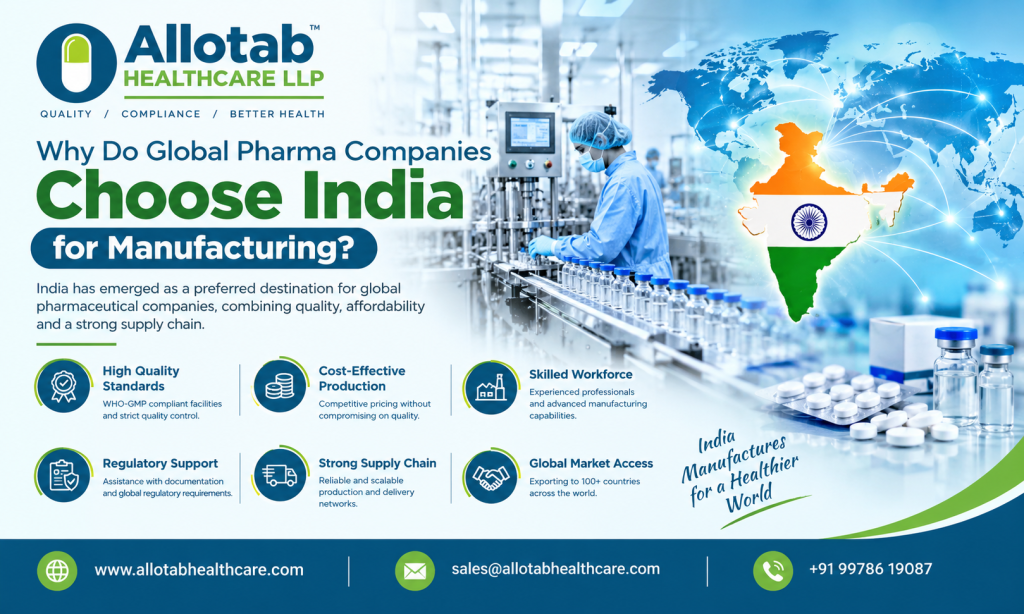
Global pharmaceutical companies choose India for manufacturing because of its established pharmaceutical ecosystem, skilled workforce, generic medicine expertise, competitive production capabilities, and international export experience. India supports pharmaceutical manufacturing across tablets, capsules, oral liquids, sterile injectables, and other dosage forms.
According to India’s Department of Pharmaceuticals, the country ranked third globally by pharmaceutical production volume and eleventh by value in FY 2024–25. Pharmaceutical exports reached approximately ₹2.46 lakh crore during that financial year. These figures demonstrate the scale of India’s pharmaceutical industry and its role in global medicine supply.
For international pharmaceutical companies, distributors, importers, and healthcare brand owners, India offers opportunities to explore contract manufacturing, third-party manufacturing, private-label products, and long-term supply partnerships.
Explore Allotab Healthcare’s pharmaceutical manufacturing capabilities to understand the product categories and manufacturing services available for international partners.

1. India’s Established Pharmaceutical Manufacturing Industry
One of the main reasons global companies consider India is its established pharmaceutical manufacturing infrastructure. The industry includes manufacturers producing generic medicines, active pharmaceutical ingredients (APIs), finished dosage forms, vaccines, and other healthcare products.
The Indian pharmaceutical industry serves domestic healthcare needs and international markets. Government data reports that India exported pharmaceutical products to 191 countries in FY 2024–25, highlighting the industry’s broad export reach.
Companies evaluating the best pharmaceutical companies in India should compare manufacturing capabilities, product portfolios, quality systems, regulatory documentation, and export experience rather than relying only on company rankings.
A suitable manufacturing partner should be able to demonstrate its capabilities for the specific product, dosage form, and destination market.
Source: Department of Pharmaceuticals – Annual Report 2025–26 and Press Information Bureau – Pharmaceutical Export Performance.
2. Competitive Manufacturing and Operating Costs
Cost efficiency is another reason international businesses evaluate Indian pharmaceutical manufacturers. Established supplier networks, experienced technical teams, manufacturing infrastructure, and production expertise can support competitive manufacturing proposals.
However, the lowest quotation does not necessarily represent the best overall value. Buyers should compare the complete cost of production, quality testing, packaging, documentation, regulatory requirements, freight, and ongoing supply.
When evaluating a pharmaceutical manufacturer in India, international companies should request a detailed quotation based on product specifications, batch size, packaging, and destination requirements.
A transparent cost comparison helps businesses make better sourcing decisions while maintaining quality and compliance expectations.
3. Expertise in Generic Medicine Manufacturing
India has a strong position in generic medicine manufacturing. Generic medicines can offer more affordable treatment options when they meet applicable quality, safety, efficacy, and regulatory requirements.
Indian generic manufacturers produce a wide range of formulations, depending on their manufacturing capabilities and regulatory authorizations. These may include tablets, capsules, oral liquids, injections, and other dosage forms.
Global companies may work with generic manufacturers to:
- Expand their product portfolios.
- Source established formulations.
- Develop supply arrangements for different markets.
- Evaluate contract manufacturing opportunities.
- Support private-label product strategies, where permitted.
- Plan commercial production according to market demand.
Product selection must consider patent status, intellectual property, local registration, product-specific approvals, and the laws of the destination market.
4. A Wide Range of Pharmaceutical Dosage Forms
International buyers often prefer suppliers that can support multiple product categories. India’s pharmaceutical ecosystem includes manufacturers specializing in solid dosage forms, liquid formulations, sterile products, topical preparations, and other pharmaceutical categories.
Depending on the specific facility and its authorizations, available dosage forms may include:
- Tablets and capsules
- Syrups and oral liquids
- Dry syrups and suspensions
- Sterile injections and infusions
- Eye drops, ear drops, and nasal sprays
- Creams, ointments, and topical preparations
- Selected specialty and oncology products
The product portfolio of each manufacturer should be verified individually. Not every company manufactures every dosage form, and sterile or specialized products require appropriate facilities and controls.
Explore Allotab Healthcare’s pharmaceutical manufacturing portfolio to review its stated manufacturing capabilities.
5. Quality Systems and Regulatory Compliance
Pharmaceutical quality is a critical consideration for global sourcing. Medicines must be manufactured, tested, stored, and distributed according to the applicable legal and regulatory requirements.
When comparing Indian pharmaceutical companies, global buyers should evaluate the following factors:
- Good Manufacturing Practice (GMP) compliance.
- Manufacturing facility and product authorizations.
- Raw-material qualification.
- In-process and finished-product testing.
- Batch records and traceability.
- Stability data and product specifications.
- Change-control and deviation-management systems.
- Product-specific regulatory documentation.
Certifications and approvals should be verified for the actual manufacturing facility and relevant product. A certification held by one facility should not automatically be assumed to cover another.
The Department of Pharmaceuticals provides background on India’s pharmaceutical industry, manufacturing infrastructure, and international market experience.
6. International Export Experience and Market Access
Global pharmaceutical companies need suppliers that understand export documentation, product registration, packaging, and shipment coordination.
India’s pharmaceutical industry has experience serving markets with different regulatory systems. Nevertheless, export experience alone does not guarantee that a particular medicine is approved for sale in every country.
Depending on the destination and product, buyers may need documentation such as:
- Certificate of Pharmaceutical Product (COPP), where applicable.
- Certificate of Analysis (COA).
- Free Sale Certificate (FSC), where applicable.
- GMP certificates and facility documents.
- CTD or ACTD registration dossiers.
- Stability reports.
- Product-specific manufacturing and quality documents.
The exact requirements must be confirmed with the destination country’s regulatory authority and the importing partner.
For companies seeking a supplier with export-oriented capabilities, Allotab Healthcare’s export services describe its support for documentation, packaging, regulatory coordination, and international pharmaceutical supply.
7. Contract Manufacturing and Third-Party Manufacturing Opportunities
Not every pharmaceutical company needs to own and operate a manufacturing facility. Some businesses choose an external manufacturing partner to produce medicines according to an agreed product specification and commercial arrangement.
Pharmaceutical contract manufacturing can help companies evaluate manufacturing partnerships while concentrating on other business functions, such as distribution, market development, sales, and brand management.
A potential manufacturing arrangement may cover:
- Product and formulation feasibility.
- Manufacturing and batch-size planning.
- Quality specifications and testing.
- Packaging and labeling requirements.
- Regulatory documentation.
- Production scheduling and supply planning.
- Commercial terms and confidentiality.
Businesses exploring third-party pharmaceutical manufacturing should confirm which products the supplier can manufacture, the applicable facility approvals, minimum order quantities, production lead times, and responsibilities for registration and product release.
8. Why Global Companies Evaluate Indian Pharmaceutical Companies
The strengths of India’s pharmaceutical ecosystem make it a sourcing option for a wide range of international businesses. However, the right supplier depends on the buyer’s individual requirements.
When comparing Indian pharmaceutical companies, global buyers should evaluate the following factors:
| Evaluation factor | What buyers should verify |
| Manufacturing | Available dosage forms and facility capabilities |
| Quality | GMP status, testing systems, and traceability |
| Regulatory | Product approvals and destination-specific documents |
| Commercial | Quotation, minimum order quantity, and payment terms |
| Supply | Production lead time and repeat-order capacity |
| Packaging | Product protection and country-specific labeling |
| Partnership | Communication, confidentiality, and ongoing support |
This approach helps buyers compare suppliers on measurable criteria instead of relying on broad claims such as “best” or “leading.”
9. Allotab Healthcare LLP: Pharmaceutical Manufacturing from India
Allotab Healthcare LLP is an India-based pharmaceutical manufacturing and export company serving international business requirements.
Its official pharmaceutical manufacturing page describes capabilities across multiple dosage forms, including tablets, capsules, oral liquids and syrups, injections, eye and ear drops, nasal sprays, and topical formulations.
The company also provides information about its contract manufacturing services and third-party manufacturing solutions.
For international pharmaceutical companies, distributors, importers, and brand owners, the next step is to discuss the required products and assess manufacturing feasibility, facility documentation, quality requirements, destination-market regulations, pricing, and supply schedules.
All product availability, certifications, documentation, and commercial terms should be confirmed directly with Allotab for the specific requirement.
Conclusion
Global pharmaceutical companies choose to evaluate India for manufacturing because the country offers an established pharmaceutical industry, generic medicine expertise, multiple dosage-form capabilities, and substantial international export experience.
The best pharmaceutical manufacturer in India for any buyer is the company that can meet the required product specifications, quality standards, regulatory obligations, commercial terms, and long-term supply expectations.
For companies assessing Indian generic manufacturers or comparing Indian pharmaceutical companies, a structured supplier evaluation is more reliable than selecting a partner based on price or ranking claims alone.
Looking for a pharmaceutical manufacturing partner in India?
Contact Allotab Healthcare LLP to discuss your pharmaceutical product requirements, contract manufacturing opportunities, documentation needs, and export plans.
Contact Allotab Healthcare LLP to discuss your pharmaceutical product requirements, contract manufacturing opportunities, documentation needs, and export plans.
Frequently Asked Questions
Why do global pharmaceutical companies choose India for manufacturing?
Global companies consider India because of its established manufacturing ecosystem, generic medicine expertise, technical workforce, broad product capabilities, and international export experience. Supplier selection still requires product-specific quality and regulatory checks.
Are Indian generic manufacturers suitable for international markets?
They may be suitable when the manufacturer, facility, and product meet the importing country’s requirements. Buyers should verify manufacturing authorization, product registration, quality documentation, and intellectual property considerations before placing an order.
What should companies check before choosing a pharmaceutical manufacturer in India?
Companies should check the facility’s GMP status, dosage-form capabilities, quality-control systems, product documentation, regulatory experience, pricing, minimum order quantity, production lead time, and export support.
What is the difference between contract manufacturing and third-party manufacturing?
The terms are sometimes used interchangeably. The exact arrangement depends on the contract, including who owns the product or brand, who manages registration, who supplies materials, and who is responsible for quality and release.
Can Allotab Healthcare LLP support international pharmaceutical buyers?
Allotab’s website describes pharmaceutical manufacturing, export-related support, and contract and third-party manufacturing services. Buyers should contact the company to confirm the availability and regulatory suitability of specific products for their market.